

HOW TO ENJOY How to enjoy Makiba Garden
Group Program] Koiwai Farm Bus Tour
Recommended for school trips, excursions and field trips!
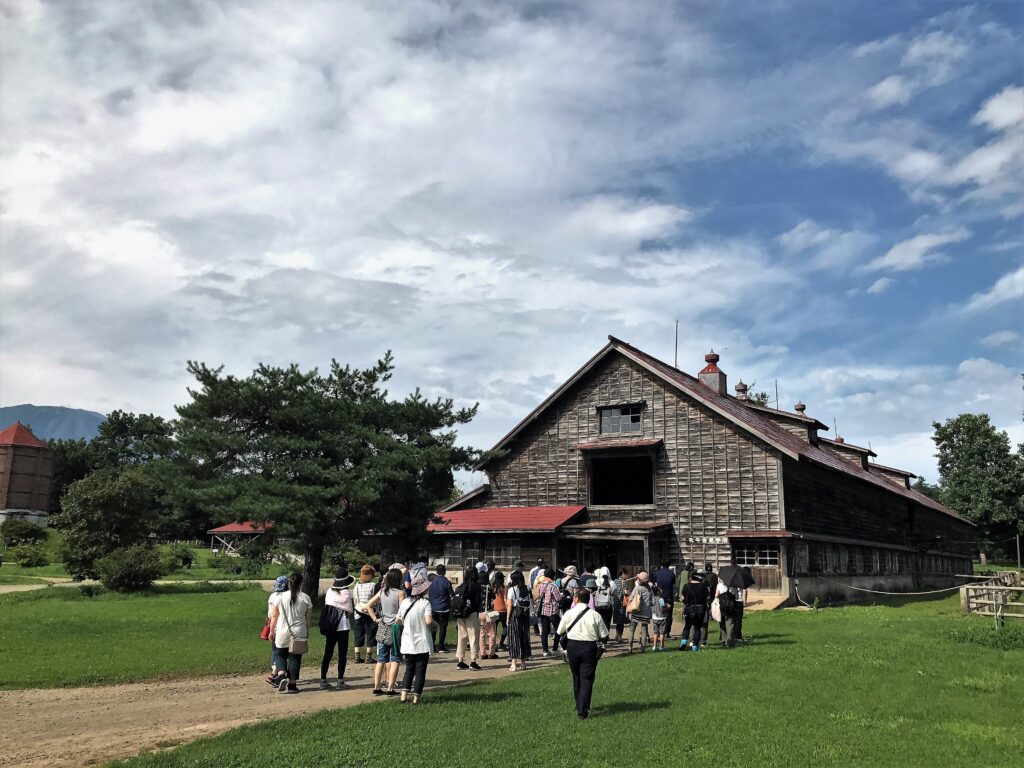
Model bus tour of Koiwai Farms [60 min.
Our expert guides will ride with you on the bus that takes you to Makibaen and visit important cultural properties that are not usually open to the public. You will also have a chance to meet Koiwai’s pride and joy, its Holstein cows.
The tour will be divided into A: Dairy Course and B: Important Cultural Properties Course.
*In A: Dairy Course, vehicles will be sprayed with disinfectant when entering the barn area.
[Course A] Dairy Farm Course
Departure from Makibaen Parking Lot
(2) Feed base
A facility that produces important feed for cows
(3) Tsurugadai Cowshed
A modern barn where about 700 milking cows live and are milked daily.
It is a stress-free environment that does not restrict the cows’ desire to act.
(4) Biomass power generation facility
There is also a biomass power generation facility on Koiwai Farm. The facility accepts livestock waste from Koiwai Farm and food scraps from the surrounding area, and uses the methane gas obtained from the methane fermentation process to generate electricity. In addition, the digested liquid (liquid fertilizer) obtained during the process is returned to the farm for grass cultivation, thus practicing sustainable and recycling-oriented agriculture.
(5) Kamimaru Cowshed
About 300 cows live in the “Kamimaru Cowshed,” the birthplace of Koiwai Farm dairy farming, and part of the raw milk produced daily is made into dairy products such as soft ice cream and pasteurized milk at the farm’s factory. Nine buildings on the farm, including four active cowsheds built between 1908 and 1935 and two silos said to be the oldest in Japan, have been designated as National Important Cultural Properties.
[Course B] Important Cultural Properties Course
1) Depart from Makibaen Parking Lot
(2) Koiwai Farm Headquarters and other important cultural properties in the Shimomaru area
Since its establishment, this area has been the hub of the farm’s management. There are five important cultural properties, including the headquarters office, described by the poet and children’s story writer Kenji Miyazawa as “the pretentious building of the headquarters.
(3) Old Amihari Road
It is an old road where Masaru Inoue conceived the idea of founding a farm in the Meiji era.
(4) Fourth floor warehouse
Built in 1916 (Taisho 5). It is a four-story wooden building for the purpose of drying and storing grain. It was equipped with an electric elevator, which was the latest technology at that time.
(5) Natural refrigerator
These refrigerators were constructed in the Meiji Era, before the introduction of electricity.
(6) Kamimaru Cowshed
About 300 cows live in the Kamimaru Cowshed, the birthplace of Koiwai Farm dairy farming. Nine buildings, including four active cowsheds built between 1908 and 1935 and two silos said to be the oldest in Japan, have been designated as National Important Cultural Properties.
Points of the tour
A farm guide will ride with you on the bus you use.
Because it is a bus tour, it is not affected by weather conditions (except for bad weather when a warning is issued). (Except for bad weather when a warning is issued.)
■You will be able to see dairy production sites and important cultural assets that are closed to the public.
We hope this tour will provide you with an opportunity to look for hints for a new society through sustainable dairy farming and recycling-oriented business.
The above tour route takes about 60 minutes. Departure time and tour time will be adjusted according to your request.
Notes on application
Reservations must be made in advance. Please apply at least 21 days in advance.
Reservations may not be accepted due to the guide’s schedule or local conditions.
In principle, the number of buses accepted is limited to two.
During the tour of dairy facilities, the buses will pass through a disinfection facility and be sprayed with disinfectant for quarantine purposes.
Fees
A guide fee of ¥20,000 per bus/vehicle (tax included) is required for each tour guide.